
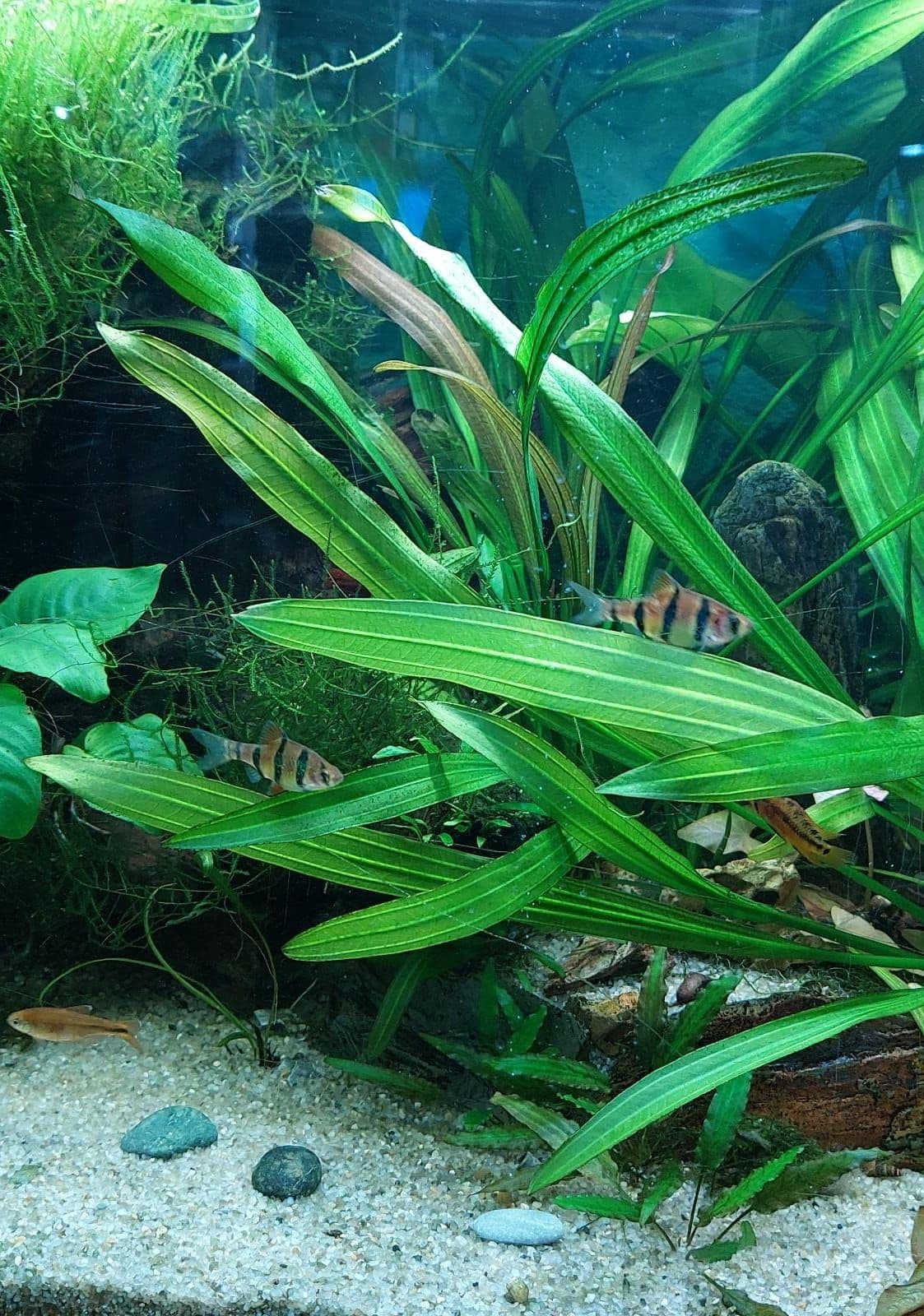
The most common question we’re asked is: ‘how do I get rid of algae in my fish tank?” The simplest answer is to make sure that your plants thrive! If your plants grow well, you won’t have a problem with algae: healthy plants will out-compete the algae for nutrients and starve it into submission, leading to a cleaner and healthier aquarium in general.
Below are some tips on helping to make sure your plants are lush and healthy, based on recreating ideal plant-growing conditions found in nature.
TOP TIPS for HEALTHY PLANTS
AQUARIUM LIGHTING Check your tank has suitable lighting. In the wild, plants get the energy they need to grow from sunlight. Sunlight contains a spectrum of colours (like a rainbow). Some of these colours are useful (red light is essential for plant growth) and some encourage algae growth (particularly blue light). Most tanks are supplied from the factory with standard ‘daylight’ tubes or LEDs with a mix of blue and white light because it’s bright. Unfortunately, while this type of light is great for lighting the tank, most aquatic plants need a different type of light to grow well.
Water absorbs most light colours but reflects blue light (which is why water looks blue) so often the useful red light emitted by standard aquarium lighting has all been absorbed or is too weak to stimulate plant growth by the time it travels down through the aquarium water to the leaves. Specialist plant-growing tubes and LEDs have been developed to mimic the spectrum of ‘underwater sunlight’. They have an increased concentration of red light to compensate for light lost through absorption and/or have a reduced blue-light emission. It is well-worth upgrading or swapping to plant-specific lighting– talk to us about your options.
CARBON DIOXIDE Install a Carbon Dioxide (CO2) system. Plants use the energy from sunlight to convert CO2 to sugars which they use like food to help them grow. Although there is some CO2 present in every tank, there is not always enough to sustain healthy plant growth. Extra CO2 is added easily and safely with a CO2 kit, which feeds a constant, measured dose of carbon dioxide into the aquarium. For smaller tanks there are bio-kits available that basically use the fermentation process to produce CO2 as a waste product. These kits are cheap to buy but the monthly running cost is approximately £10. For larger aquaria (100 litres +) the most cost-effective option is always a pressurised kit with a refillable bottle. These have a metal CO2 canister with a pressure gauge and should last several months. When the bottle is empty, simply bring it into the shop and we will refill it while you wait. Have a look at the system running on our display tank and ask us to show you how it works. You can also get very good results using a liquid carbon additive. These are very cost effective—our most popular brand would cost about 5p per day for a 100 litre tank, but the downside is you need to have the time and discipline to add a little bit every day, you can’t just add it once a week and hope for the best!
AMOUNT OF LIGHT Check the amount of time your aquarium lights are on each day. Make sure the lights are on for a maximum of 7-8 hours per day—ideally two blocks of 4 hours with a few hours of darkness in the middle. This mimics the lighting patterns in the wild where tropical storms tend to roll in and darken the sky through the middle of the day. It has no effect on plant growth but conveniently disrupts the algae growth cycle!
FERTILISERS Just like us, plants need trace elements, vitamins and minerals. Small amounts of these are found in the water naturally but are quickly used up by the plants so you will need to regularly add more to keep your plants healthy. Some fertilisers actually cause algae(!) so make sure you use good quality aquatic-safe products. We use and recommend a combination of liquid and tablet additives including the option of a slow-release under-gravel fertiliser layer for long-term slow-release nutrients.
GRAVEL Check you have the right type of gravel. Ideally use quartz gravel with a grain size of 1-3mm. This allows healthy roots to develop and nutrients and water to circulate. Particles of food and fish waste would fall between grains of larger grade gravel and rot, causing high nitrate levels and excessive algae growth. Fine sand is very difficult to keep looking clean (debris just gathers on top like tumbleweed!) and often ‘compacts’ around roots, causing anaerobic bacteria which will make the roots rot.
PLANTS Make sure there are plenty of plants in the aquarium—they will compete with the algae for nutrients. Although they require more maintenance, fast-growing plants are desirable because they use the excess nutrients more quickly. The more plants, the better—look at our display tanks for ideas. Ideally 60-80% of the available space should be live plants
SUNLIGHT Keep the tank out of direct sunlight. If the tank can’t be relocated, keep the curtains drawn in that room or try sticking a backing poster on the side of the tank that is facing the window.
FISH FOOD Make sure you aren’t over-feeding your fish as a build-up of fish waste or uneaten food will cause algae. Fish should eat one or two pellets twice a day—more food or larger portions will be cheerfully eaten but just be excreted as waste and cause algae. Feed a good-quality food to keep your fish healthy but minimise the amount of waste.
AIR PUMPS Avoid additional aeration—too much oxygen can oxidise the nutrients in the water, which prevents the plants absorbing them. This will stunt plant growth and allows algae to thrive at the plant’s expense!
WATER HARDNESS Test the water and make sure the carbonate hardness (KH) level is at least 3. The KH is a measure of how hard or soft the water is. If the water is too soft the plants won’t be able to covert the CO2 properly, which can stunt their growth. If the level is too low, add a KH buffer to raise it to the right level again.
NITRATE and PHOSPHATE Algae feeds on nitrate and phosphate so test your levels regularly and keep up with maintenance/cleaning. There are lots of good water treatments and additives available to help reduce high levels if necessary.
ALGAE EATERS Include algae-eating fish, snails and shrimp in your community to help control any algae that grows. Avoid larger plecs as they can quickly outgrow an aquarium and can damage plants as they move around. Sucking Loaches and Otocinclus stay much smaller and do a very good job of cleaning the glass.
ALGAECIDES Use anti-algae products only as a last resort—remember that they treat the symptoms but do not solve the underlying problem. They kill the algae but don’t remove it, so you will have the secondary problem of a large amount of decomposing organic matter, which will lead to high waste levels and more algae! Without making changes to your routine or set-up you will either have to learn to live with algae or be permanently dependant on buying algaecides!
CHILL OUT Don’t ‘panic-clean’! A big water change just adds fresh nutrients to the aquarium so it will look lovely for a day then cause more algae. Changing all the sponges or washing the gravel or sponges under the tap kills all the good bacteria, which slows down the breakdown of waste and also causes more algae!
Got questions? Talk to us :) 01423 869590 harrogate_aquatic@hotmail.co.uk